
Lab 1: Membrane Physiology
Step 1: Read the background information before starting the first activity.
Exercise Overview:
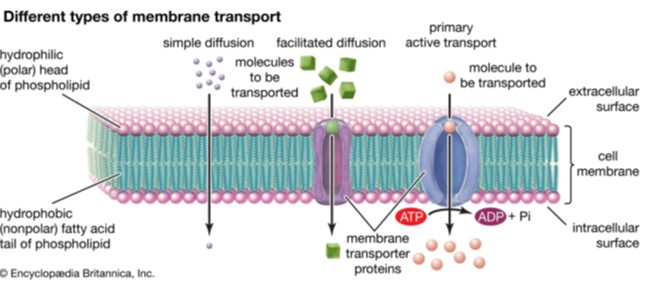
The molecular composition of the plasma membrane allows it to be selective about what passes through it. It allows nutrients and appropriate amounts of ions to enter the cell and keep out undesirable substances. For that reason, we say that the plasma membrane is selectively permeable. Valuable cell proteins and other substances are kept within the cell, and metabolic wastes pass to the exterior. Transport through the plasma membrane can occur in two basic ways: either passively or actively. In passive processes, the transport process is driven by concentration or pressure differences (gradients) between the interior and exterior of the cell. In active processes, the cell provides energy (ATP) to power the transport. Two key passive processes of membrane transport are diffusion and filtration. Diffusion is an important transport process for every cell in the body. Simple diffusion occurs without the assistance of membrane protein, and facilitated diffusion requires a membrane-bound carrier protein that assists in the transport. In both simple and facilitated diffusion, the substance being transported moves with (or along or down) the concentration gradient of the solute (from a region of its higher concentration lo a region of its lower concentration). The process does not require energy from the cell. Instead, energy in the form of kinetic energy comes from the constant motion of the molecules. The movement of solutes continues until the solutes are evenly dispersed throughout the solution. At this point, the solution has reached equilibrium.
A special type of diffusion across a membrane is osmosis. In osmosis, water moves with its concentration gradient. From a higher concentration of water to a lower concentration of water. It moves in response to a higher concentration of solutes on the other side of a membrane. In the body, the other key passive process, filtration, usually occur only across capillary walls. Filtration depends upon a pressure gradient as its driving force. It is not a selective process. It is dependent upon the size of the pores in the filter. The two key active processes (recall that active processes require energy) are active transport and vesicular transport. Like facilitated diffusion, active transport uses a membrane bound carrier protein. Active transport differs from facilitated diffusion because the solutes move against their concentration gradient and because ATP is used to power the transport. Vesicular transport includes phagocytosis, endocytosis, pinocytosis, and exocytosis. These processes are not covered in this exercise. The activities in this exercise will explore the cell transport mechanism individually.
Step 2: complete the five activities of the Cell Transport Mechanisms and Permeability Exercise located in the PhysioEx software program that can be found on the desktop of the lab computer. Note: Make sure to follow the activity step by step.
Make sure to take the pre-lab and post-lab quizzes before moving on to the experimental simulations.
To summarize your results, fill out the corresponding tables in your lab report sheet for the first four activities as you complete the activity that focus on each of the key concepts related to membrane physiology.
Note: You will obtain the values for the tables once you hit the record data button after running an experimental simulation at the bottom of the screen.
You can skip the review sheet questions as some of these are located on your lab report sheet instead.
Step 3: be sure to answer all of the questions in the lab report sheet and to ask any questions you may have stemming from the activities before leaving the lab.
Note: You can save the results from each activity as a PDF report if you would like to study from it later on.