
Comparative Physiology Oral Presentations
Background
Comparative physiology is a field within animal physiology that examines the similarities and differences in how living organisms function and have adapted to various environments, often focusing on how physiological systems have been altered in extreme environments. Understanding these adaptations from different model organisms leads to a better understanding of not only fundamental biological processes, but how they might be altered in a diseased state. Therefore, comparative physiology can result in significant medical breakthroughs to improve human quality of life.
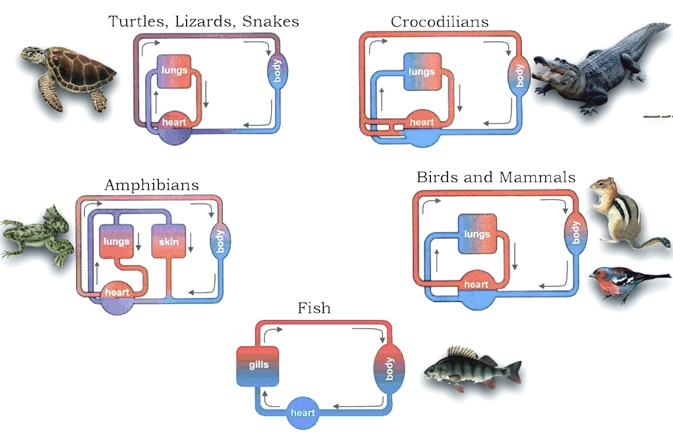
Comparative physiology compares and contrasts biological systems that are required to sustain life, like the circulatory, nervous, respiratory, and endocrine systems, across different species. Comparative physiologists investigate how these systems have evolved and diversified in response to different environments and lifestyles. Typically, investigations explore how animals adapt to various environmental challenges like desiccation, temperature, salinity, and oxygen availability. Comparative physiology utilizes diverse organisms as models to understand human physiology and disease, as some species physiology in a given environment may be more similar to humans than traditional lab animals like mice. The field is known as being integrative, meaning that to fully understand the physiology, an understanding of multiple levels of biological organization is needed, this includes knowledge of molecules and cells to tissues, organs, and whole organisms.
Assignment
The goal of the assignment is to educate the class and gain additional exposure of different examples of how the physiological systems evolved across three different organisms adapting to a specific environment for survival as well as implications of this understanding for the benefit of humans, in a 15-minute oral presentation. First, however you will give a 2-minute elevator talk to the class describing the significance of your research that is geared towards a general audience (the mainstream public). See below for details on what is expected for the elevator talk and 15-minute oral presentation. Tips are given for giving an excellent oral presentation as well as a grading rubric at the end so that expectations are clear for the oral presentation.
How to make an excellent scientific oral presentation
When being graded on your oral presentation, you will be graded on the following two aspects: the content of the presentation and the delivery of the presentation. Although the content of the presentation will be more heavily weighted for grading purposes, the delivery of the presentation should not be overlooked as this can impede the understanding of the content of your presentation. In this lab you will have an opportunity to work on your oral presentation which you will present the next week.
Content of presentation
The following main areas must be covered in your presentation in this same following order, this is a standard convention when presenting scientific talks at conferences…
Elevator Talk
This is a 1-2 minute summary of what you did and what you found described in a way such that someone from the general public could understand what you are talking about. Include the importance of your analysis and why the general public should care about it. A very useful skill to have as a scientist, sounds easy but it actually takes some practice! You will give these before your oral presentation.
Oral Presentation
– Introduction
Starts off broad and then gets more specific. Attempts to capture the audience’s attention. Contains general background information about the three organisms chosen for the comparative physiology analysis and a justification for picking them.
– In–depth biological details of the physiological system you are comparing
– A discussion on how the physiological system is adapted for survival of the organism in a particular environment
– A comparison of the physiological system across the three species chosen
– Relevance for biological research and implications for humans of understanding how these physiological systems evolved in the different environments
Delivery of presentation
 www.elsevier.com/connect/how-to-give-a-dynamic-scientific-presentation
Convey your ideas and enthusiasm – and avoid the pitfalls that put audiences to sleep
By Marilynn Larkin Posted on 4 August 2015
Share story:
Giving presentations is an important part of sharing your work and achieving recognition in the larger medical and scientific communities. The ability to do so effectively can contribute to career success.
However, instead of engaging audiences and conveying enthusiasm, many presentations fall flat. Pitfalls include overly complicated content, monotone delivery and focusing on what you want to say rather than what the audience is interested in hearing.
Effective presentations appeal to a wide range of audiences — those who work in your area of interest or in related fields, as well as potential funders, the media and others who may find your work interesting or useful.
There are two major facets to a presentation: the content and how you present it. Let’s face it, no matter how great the content, no one will get it if they stop paying attention. Here are some pointers on how to create clear, concise content for scientific presentations – and how to deliver your message in a dynamic way.
Presentation pointers: content
Here are five tips for developing effective content for your presentation:
1. Know your audience. Gear your presentation to the knowledge level and needs of the audience members. Are they colleagues? Researchers in a related field? Consumers who want to understand the value of your work for the clinic (for example, stem cell research that could open up a new avenue to treat a neurological disease)?
2. Tell audience members up front why they should care and what’s in it for them. What problem will your work help solve? Is it a diagnostic test strategy that reduces false positives? A new technology that will help them to do their own work faster, better and less expensively? Will it help them get a new job or bring new skills to their present job?
3. Convey your excitement. Tell a brief anecdote or describe the “aha” moment that convinced you to get involved in your field of expertise. For example, Dr. Marius Stan, a physicist and chemist known to the wider world as the carwash owner on Breaking Bad, explained that mathematics has always been his passion, and the “explosion” of computer hardware and software early in his career drove his interest to computational science, which involves the use of mathematical models to solve scientific problems. Personalizing makes your work come alive and helps audience members relate to it on an emotional level.
4. Tell your story. A presentation is your story. It needs a beginning, a middle and an end. For example, you could begin with the problem you set out to solve. What did you discover by serendipity? What gap did you think your work could fill? For the middle, you could describe what you did, succinctly and logically, and ideally building to your most recent results. And the end could focus on where you are today and where you hope to go.
- Start with context. Cite research — by you and others — that brought you to this point. Where does your work fit within this context? What is unique about it? While presenting on organs-on-chips technology at a recent conference, Dr. Donald Ingber, Director of the Wyss Institute for Biologically Inspired Engineering at Harvard, described the pioneering work of others in the field, touched on its impact, then went on to show his unique contributions to the field. He did not present his work out of context, as though his group were the only one achieving results.
- Frame the problem: “We couldn’t understand why our experiment wasn’t working so we investigated further”; “We saw an opportunity to cut costs and speed things up.”
- Provide highlights of what you did, tied to the audience’s expertise and/or reasons for attending your presentation. Present the highlights in a logical order. Avoid going into excruciating detail. If people are interested in steps you don’t cover, they’ll ask and you can expand during the Q&A period. A meeting I covered on educational gaming gave presenters just 10 minutes each to talk about their work. Most used three to five slides, making sure to include a website address for more information on each slide. Because these speakers were well prepared, they were able to identify and communicate their key points in the short timeframe. They also made sure attendees who wanted more information would be able to find it easily on their websites. So don’t get bogged down in details — the what is often more important than the how.
- Conclude by summing up key points and acknowledging collaborators and mentors. Give a peek into your next steps, especially if you’re interested in recruiting partners. Include your contact details and Twitter handle.
5. Keep it simple. Every field has its jargon and acronyms, and science and medicine are no exceptions. However, you don’t want audience members to get stuck on a particular term and lose the thread of your talk. Even your fellow scientists will appreciate brief definitions and explanations of terminology and processes, especially if you’re working in a field like microfluidics, which includes collaborators in diverse disciplines, such as engineering, biomedical research and computational biology.
I’ve interviewed Nobel laureates who know how to have a conversation about their work that most anyone can understand – even if it involves complex areas such as brain chemistry or genomics. That’s because they’ve distilled their work to its essence, and can then talk about it at the most basic level as well as the most complicated. Regardless of the level of your talk, the goal should be to communicate, not obfuscate.
Presentation pointers: you
Here are 10 tips to help you present your scientific work and leave the audience wanting more.
1. Set the stage. Get your equipment ready and run through your slides if possible (use the “speaker ready” room if one is available). If you’ve never been in the venue, try getting there early and walk the room. Make sure you have water available.
2. Get ready to perform. Every presentation is a performance. The most important part is to know your lines and subject. Some people advocate memorizing your presentation, but if you do so, you can end up sounding stilted or getting derailed by an interruption. When you practice, focus on the key points you want to make (note them down if it helps) and improvise different ways of communicating them.
Related resource
It’s well known that a majority of people fear public speaking — and even those who enjoy it may get stage fright. Fear of public speaking will diminish with experience. I’ve been presenting and performing for many years but still get stage fright. Try these strategies to manage the fear:
- Breathe slowly and deeply for a few minutes before your talk.
- Visualize yourself giving a relaxed talk to a receptive audience. This works best if you can close your eyes for a few minutes. If you’re sitting in the audience waiting to be introduced and can’t close your eyes, look up at the ceiling and try visualizing that way.
- Do affirmations. Tell yourself you are relaxed, confident — whatever works for you. Whether affirmations are effective is a matter of debate, but you won’t know unless you try.
- Assume one or more “power poses,” developed by social psychologist and dancer Dr. Amy Cuddy of the Harvard Business School, before giving your presentation. She demonstrates them in this TED talk. Power poses are part of the emerging field of embodiment research (see a comprehensive collection of articles related to this research in the journal Frontiers in Psychology). Research on power poses has yielded mixed results to date, but they’re worth a try.
3. Stride up to the podium. Seeing you walk energetically energizes the audience. They expect you to engage them and you have their attention.
4. Stand tall and keep your chest lifted. It’s more difficult to breathe and speak when your shoulders are rolled forward and your chest caves in. Standing tall is also a way of conveying authority. If you’re presenting from a sitting position, sit up in your seat, keep your arms relaxed and away from your sides (i.e., don’t box yourself in by clasping your arms or clasping your hands in your lap).
5. Smile. Not only will you appear more relaxed if you smile, but research has shown that smiling — even when forced — reduces stress. Plus the audience enjoys watching and listening to someone who’s smiling rather than being stern or overly serious, especially if your topic is complicated.
One of the most enjoyable presentations I’ve covered was on animal versus human cognition. It dealt with the evolution and activation of different parts of the brain. By inserting anecdotes in with complex didactic information, presenter Dr. Onur Güntürkün, Professor of Biological Psychology at the Ruhr-Universität Bochum in Germany, made the topic accessible and compelling.
6. Speak up. The audience came to your talk so they really do want to hear what you have to say. If a microphone is available, use it. I’ve seen countless presenters stand in front of a microphone yet somehow manage not to talk into it. Talk from your diaphragm, not your throat, to give your voice authority and resonance.
7. Take your time. A moment or two of silence as you gather your thoughts or move to a new topic can actually make the audience pay attention. Don’t feel you have to talk continuously, and avoid filler phrases, such as “you know.”
8. Talk to the audience, not the screen. Making eye contact with one or more friendly faces can relax you and help you connect to the audience. It will also prevent you from reading your slides, which you don’t want to do unless absolutely necessary (for example, if you forget the statistics supporting a particular point).
9. Stick to your time frame. We’ve all done it, but it’s not fun to have to cycle rapidly through your last 10 slides because the moderator has given you a two-minute warning and you’re nowhere near the end. Try to pace yourself. When preparing your slides and practicing (i.e., rehearsing for your performance), make a note on the slide you think you should be discussing when you’re about midway through your talk. This gives you a benchmark and lets you know if you need to speed up or slow down the rest of the presentation.
10. Don’t drift off at the end. I’ve seen people read their summary slide, then nod and walk away. Instead, say “That concludes my presentation. Thank you for your attention.” If appropriate, ask if there are any questions or tell the audience they will have an opportunity to ask questions later.
Six dos and don’ts of PowerPoint slides
1. Less is more. Although there are no “rules,” I’ve found that 20-25 slides work well for a one hour presentation. You’ll have a better idea what works for you if you time yourself during a practice session.
2. Create sections. Use a title slide to start a new section or change the subject. This will also help you organize your presentation and make sure it flows logically.
3. Avoid clutter. Stick to three to five bullet points per slide at most. Bullet points should contain key words — not complete sentences. For examples of what not to do, see this recent editorial in the Washington Post, which urges a ban on PowerPoint presentations.
4. Make it readable. Rule of thumb for fonts: 28-40 point for headlines; 18-28 for text; 12-14 for references. Use sans serif fonts, and make sure you have a strong contrast between the background and text (e.g., black or dark blue text on a white background; white text on a blue background). Don’t use ALL CAPS; underscore a point by putting it in italics or bold (underlining can make the text more difficult to read).
5. Use visuals. In a recent talk, presenters explained why biological image processing and analysis is a hot field in laboratory R&D. The reason is simple: you can tell a lot more about cells with an image versus a cell count. The same is true of your presentation: a single image of something particularly relevant to your work is more engaging and has the potential to convey more information than words.
That said, it’s important to keep the visual simple — an image of a single cell or pathway, for example. If you use graphs to show comparisons or results, indicate what the axes represent and which variables (ideally, not more than two or three) you’re displaying.
Generally, steer clear of videos. One of the few effective videos I’ve seen was of a Caledonian crow creating a tool to obtain food, which Dr. Güntürkün included in the presentation referred to above. Videos of in vitro experiments and imaging results rarely help support a point because the low resolution makes everything look grainy.
6. Check your spelling. Nothing takes away from credibility like misspelled words, especially if they’re up on large screen for a minute or more — or worse, repeated throughout your presentation. After you use spell check, proof your presentation yourself. Let a day go by if possible; it’s easier to pick up errors after a break.
Lab 1: Oral presentation grading rubric
Grading Rubric for oral presentation (25 points)
Name of student:_______________________Date:_____________
|
|
|
Comments |
Points accrued |
Maximum points possible |
|
Content of presentation – contains background information about the organisms chosen, goes into detail of a physiological system with an explanation of how this system functions and has adapted to a given environment, then links this to its survival. Compares the physiological system across three organisms, discusses the importance of the analysis for biological research and how it can potentially benefit humans. |
|
|
|
10 |
|
Delivery of presentation – a good amount of eye contact, body language is appropriate, loud and clear voice, refers to slides or poster when discussing relevant points, good transitions between slides so that the presentation flows well. The presentation is no more than 15 minutes. |
|
|
|
5 |
|
Visual appeal of presentation – the slides/poster are well balanced and visually appealing, there is enough contrast and the text is easy to read, the figures are formatted so they are easy to read. There are headings to identify the separate parts of the presentation. |
|
|
|
2.5 |
|
Elevator talk – the talk is gauged for a general audience, it is succinct, clear, well-rehearsed, and provides an overview an importance of the comparative analysis. The talk lasts around no more than 2 minutes. |
|
|
|
2.5 |
|
Literature cited – references properly formatted in a consistent scientific journal style, this is presented at the end of the talk as full references. |
|
|
|
2.5 |
|
Answering questions – is able to give some sort of educated answer to the questions asked, which reflects additional reading of previous literature, questions are asked when others are presenting. |
|
|
|
2.5 |