
Lab Report Guidelines
Your animal physiology laboratory report write up assignment:
From Lab 11: Osmoregulation, the goal will be to generate a lab report as if you were to submit a manuscript for publication in a peer reviewed journal. The formatting guidelines and expectations will correspond to this. The final draft to be submitted must include at least one scientific figure complete with a figure caption. You are required to properly report the statistics for the worm weight gain from the class dataset when comparing across the different saltwater concentrations and compare this against the fiddler crabs. Qualitative observations should be reported as well in the results section. Methods should be reported detailed enough such that someone could repeat the experiment. In addition, the report should include at least three primary sources (peer reviewed journal articles only) other than your laboratory manual, the suggested reading, and your textbook. This paper has a 4-page limit on the main text (not including Abstract, Figures, Acknowledgements or Literature Cited). Papers should be double-spaced with 1-inch margins and be written in Times New Roman 12 pt font. Each report should contain an Abstract, Introduction, Materials and Methods, Results, Discussion, Figures, Acknowledgements, and Literature Cited section.
For more information on how to write up a lab report and to get additional guidance see the PDF file on Blackboard entitled: “How-To-Write-A-Lab-Report-Guide”
Sample Lab Report
Title: Testing the Biological Species Concept in Drosophila melanogaster and Drosophila willistoni
Abstract
The biological species concept claims that a species consists of a population that can interbreed but that cannot breed with foreign populations. As a result of reproductive isolation, two populations that have been separated for a long time are less likely to mate than two species that have been separated for a short time. In this experiment, we compared changes in latency to copulation, singing, and the general morphology of Drosophila willistoni and Drosophila melanogaster populations from Peru (DMP) and Hawaii (DMH) in order to determine whether prezygotic barriers had developed between them and whether they could still be considered the same species according to the biological species concept. We hypothesized that the longer the populations of fruit flies had been separated from each other, the longer the latency to copulation and singing would be. Latency to copulation and to singing was recorded every minute for 30 minutes via scan sampling, and morphological observations were recorded before the experiment. We discovered that DMP and DMH fruit fly populations can be considered the same species and that D. willistoni would be considered a different species according to the biological species concept. In the future, it would be beneficial to ascertain the latency to copulation between male DMP and female DMH and D. willistoni flies as well as determine the extent to which morphological differences affect mate choice.
Introduction
According to the biological species concept, a species is a population that can interbreed but that cannot breed with other populations (Diamond, 2005). Speciation, or the independent evolution of two isolated populations into different species, results from reproductive isolation, which consists of postzygotic and prezygotic barriers that prevent gene flow between the populations (Nanda & Singh, 2012). Prezygotic barriers develop as mutations arise that give individuals a reproductive advantage by allowing them to distinguish between members of their own species and foreign ones (Sadava et al. 2014). Behavioral isolation, a barrier that involves species-specific signals in mating displays, facilitates recognition among viable mates of the same species (Nanda & Singh, 2012). For instance, fruit flies differentiate between each other through species-specific pre-copulatory behaviors like the vibration of a male fruit fly’s wing when singing to a female (Iliadi et al. 2009; Nanda & Singh, 2012). Previous studies have found that reproductive barriers tend to increase the longer populations are separated (Coyne & Orr, 1997). Similarly, the biological species concept suggests that populations are less likely to breed the longer that they have been isolated from each other (Biology 2 Laboratory Manual, Swarthmore College, 2017).
In order to determine whether prezygotic barriers have developed between isolated populations of fruit flies and whether the populations have diverged as species, we mated populations of Drosophila melanogaster from Peru (DMP) and Hawaii (DMH) that have been separated for 150 to 10,000 years, as well as mated Drosophila willistoni that have been isolated for 35 million years (Keller, 2007; Biology 2 Laboratory Manual, Swarthmore College, 2017). We hypothesized that the longer the populations had been isolated from each other, the longer the latency to copulation and to singing would be.
Materials and Methods
QUANTITATIVE MEASUREMENTS AND ANALYSIS
Latency to copulation and to singing was recorded each minute via scan sampling. Ten female DMP flies were mated with ten male DMP, DMH, or D. willistoni flies per trial. Trials ended when flies copulated or when 30 minutes elapsed. A Kruskal-Wallis test assessed the differences in latency to copulation and singing between the DMH, DMP, and D. willistoni fruit flies. A Wilcoxin rank-sum test with a Bonferroni correction clarified these differences (Biology 2 Laboratory Manual, Swarthmore College, 2017).
QUALITATIVE MEASUREMENTS
Behavioral differences were observed through ad libitum sampling of two DMP flies and used to create an ethogram. Morphological differences between populations were also observed (Biology 2 Laboratory Manual, Swarthmore College, 2017).
Results
QUANTITATIVE RESULTS
Differences between the latency to copulation of D. willistoni fruit flies to DMH and DMP flies were statistically significant, as exhibited by the D. willistoni flies’ lack of copulation (Fig. 1;
Differences between the latency to singing of the D. willistoni flies to DMH and DMP fruit flies were also statistically significant, as exhibited by the D. willistoni flies’ higher placement on the graph (Fig. 2;
QUALITATIVE RESULTS
DMP flies had light yellow bellies and dark backs. One third of their tails were black, and their wings reflected a rainbow of light. They were the largest of all three fly species. Though smaller, DMH flies boasted a similar morphology to DMP flies. Half of their tails were black, and their wings reflected less light. Both DMP and DMH had dark red eyes and dark bands across their torsos. D. willistoni flies were the smallest, lacked any black on their tails, were lightest in color, and did not have reflective wings.
Discussion
Our hypothesis that populations separated for a long time would be less likely to mate was supported. While DMP flies copulated within their own population and within the DMH population, D. willistoni flies did not copulate at all (Fig. 1). This suggests that D. willistoni is a different species from the DMH and DMP flies, as per the biological species concept, and that the amount of time populations are separated may be a practical indicator of speciation. (Biology 2 Laboratory Manual, Swarthmore College, 2017).
In terms of singing, the DMH and DMP males immediately courted the DMP females, while the D. willistoni males did not (Fig. 2). This suggests that singing likely evolved into a prezygotic barrier between the species, which agrees with a previous study that found that D. willistoni males rarely display pre-copulatory behaviors in the presence of D. melanogaster females (Wilson & Tompkins, 1997).
Despite their few attempts at courtship, D. willistoni flies did not attempt to copulate due to behavioral isolation, which necessitates a species-specific pre-copulatory behavior and morphological display to prompt mating (Ma et al. 2010). The different morphologies of each population likely influenced mate choice and served as indicators of reproductive barriers. DMP and DMH flies’ similar black tail bands, coloration, and wing reflectivity reflect their short time apart, and likely contributed to their short latency to singing (Fig. 2). Their short latency to copulation resulted from their shared wing shaking behavior, the resulting vibrations, and their wing reflectivity (Fig. 1; Ma et al. 2010; Iliadi et al. 2009). D. willistoni flies’ long latency to singing was likely due to their light color and small size (Fig. 2). Some males eventually sang to DMP females because of their few shared morphological traits, but the lack of familiar visual and auditory pre-copulatory behaviors like wing reflectivity and vibrations prevented copulation (Fig. 2; Wilson & Tompkins, 1997; Ma et al. 2010; Iliadi et al. 2009). Alternatively, copulation may not have occurred because females, as the resource-limited sex, are more discriminating of potential mates (Wu et al. 1995). By delaying copulation with an unfamiliar male she is more likely to encounter a same-species male and can invest her energy and resources into producing young that continue her line (Biology 2 Laboratory Manual, Swarthmore College, 2017).
In the future, it would be beneficial to repeat this experiment with male DMP and female DMP, DMH, and D. willistoni fruit flies as previous studies have shown that D. melanogaster males actively woo D. willistoni females and occasionally copulate with them (Wilson & Tompkins, 1997). It would also be beneficial to determine the extent to which morphological differences affect mate choice when compared to behavioral differences.
Figures
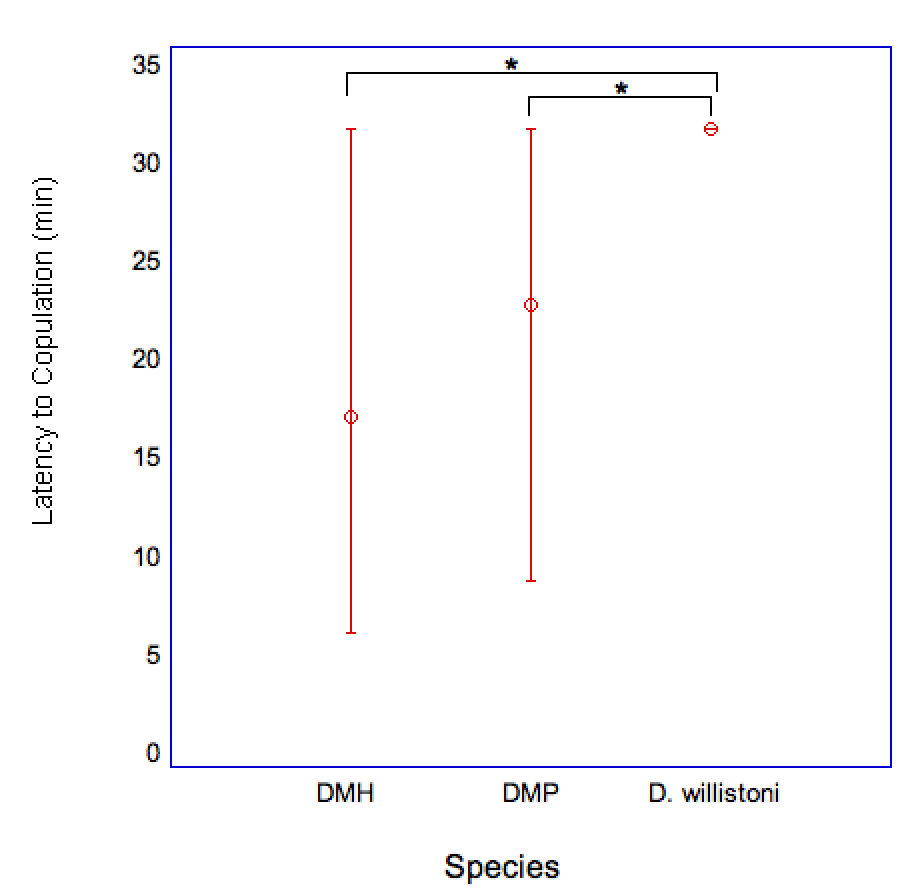
Figure 1. Median latency to singing in D. willistoni and Drosophila melanogaster from Hawaii (DMH) and Peru (DMP) fruitfly populations over a period of 30 minutes. Flies that did not copulate within the time allotted were assigned a latency of 30 minutes by default. All females were DMP fruitflies. Latency to mating behaviors and copulation were recorded every minute via scan sampling. Error bars indicate the interquartile range around the median. Kruskal-Wallis test results indicate that the differences between the three groups were statistically significant. Wilcoxin rank-sum test results with a Bonferroni correction yielding 0.016 indicate that the differences between the latencies of the DMH and DMP populations were not significant. The differences between the D. willistoni (n=30) and the DMP (n=38) were significant (P<0.0001). The differences between the D. willistoni (n=30) and DMH (n=37) were also significant (P<0.0001). Asterisks indicate significance.
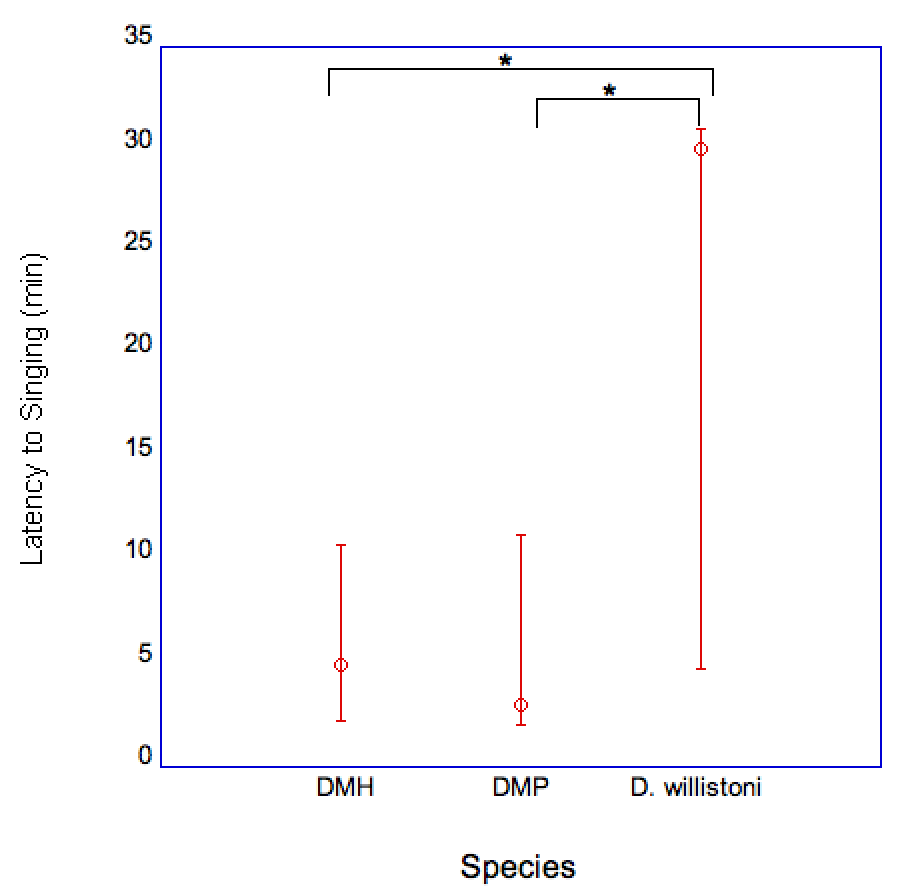
Figure 2. Median latency to singing in D. willistoni and Drosophila melanogaster from Hawaii (DMH) and Peru (DMP) fruitfly populations over a period of 30 minutes. All females were DMP fruitflies. Latency to mating behaviors and copulation were recorded every minute via scan sampling. Error bars indicate the interquartile range around the median. Kruskal-Wallis test results indicate that the differences between the three groups were statistically significant. Wilcoxin rank-sum test results with a Bonferroni correction yielding 0.016 indicate that the differences between the latencies of the DMH and DMP populations were not significant. The differences between the D. willistoni (n=30) and the DMP (n=28) were significant (P<0.0001). The differences between the D. willistoni (n=30) and DMH (n=32) were also significant (P=0.0008). Asterisks indicate significance.
Acknowledgements
This experiment was carried out as a team effort in which my team member Gabriel Brossy de Dios mated the flies while I recorded the data from scan sampling. We are especially grateful to Phil Kudish, Rachael Merz, Chris Mayack, and Emma Close for advice on the analysis of our results and the writing of this paper. We would also like to thank Michelle McEwen for aid in the writing process of this paper. Finally, we are grateful to Swarthmore College for sponsoring this experiment.
Literature Cited
Biology 2 Laboratory Manual. 2017. Swarthmore College, PA.
Coyne A and Orr H. 1997. “Patterns of speciation in drosophila” revisited. Evolution, 51: 295-303.
Diamond, J. 2005. Obituary: Ernst Mayr (1904–2005). Nature, 433: 700-701.
Illiadi KG, Kamyshev NG, Popov AV, Iliadi NN, Rashkovetskaya EL, Nevo E, Korol AB. 2009. Peculiarities of the courtship song in the Drosophila melanogaster populations adapted to gradient of microecological conditions. Journal of Evolutionary Biochemistry and Physiology, 45(5): 579-588.
Keller, A. 2007. Drosophila melanogaster’s history as a human commensal. Current Biology, 17: R77–R81.
Ma D, Smith AP, Zheng Z, Michalak P. 2010. Sensory components of behavioral isolation between Zimbabwe and cosmopolitan Drosophila melanogaster. Israel Journal of Ecology and Evolution, 56: 197-206.
Nanda P and Singh BN. 2012. Behavioural reproductive isolation and speciation in Drosophila. Journal of Biosciences, 37: 359-374.
Sadava D, Hillis DM, Heller HC, Berenbaum MR. 2014. Section 23: Speciation. Life: the science of biology. Gordonsville (VA): Sinauer Associates, Inc. p. 467-484.
Wilson A and Tompkins L. 1997. Sexual interactions between two distantly related Drosophila species, D. melanogaster and D. willistoni (diptera: drosophilidae). Journal of Insect Behavior, 10: 771-781.
Wu C, Hollochier H, Begun D, Aquadro C, Xu Y, Wu M-L. 1995. Sexual isolation in Drosophila melanogaster: a possible case of incipient speciation. Proceedings of the National Academy of Sciences USA, 92: 2519-2523.
Grading Rubric for lab report final draft (25 points total)
Name of student: _______________________Date:_____________
|
|
Comments |
Points accrued |
Maximum points possible |
|
Background and introduction – starts off broad and gets more specific leading into the hypotheses of interest. Adequate use of references to determine the gap of knowledge that is of interest to investigate. |
|
|
5 |
|
Hypotheses – Clearly stated hypotheses and/or aims of the project |
|
|
2.5 |
|
Materials and methods – contains all necessary details to carry out the experiment and clearly states the procedure to be used. Materials needed are included while describing the procedure. |
|
|
2.5 |
|
Results – results are stated concisely and specifically, they are not interpreted, statistics are internally cited along with corresponding figures. |
|
|
2.5 |
|
References – 3 or more references cited internally and formatted correctly. Reference list is provided at the end of the report.
|
|
|
1 |
|
Discussion – the results are interpreted, support of hypotheses is addressed, and speculation of results is included with the inclusion of other primary literature with internal citations. The end of the discussion becomes broad with the significance of the study being addressed. |
|
|
5 |
|
Title – Title is creative, informative, and concise. |
|
|
1 |
|
Formatting – 1 inch margins, 12 pt Times New Roman font, doubled line spacing, within the 4 page limit not including title, abstract, figures and references |
|
|
1 |
|
Writing mechanics – writing is well-organized, formal, concise, and informative. |
|
|
2.5 |
|
Figures – axes are labeled with units, figure caption is included, statistics are reported within the figure caption. |
|
|
2 |