
10 Human Genetics
Learning Objectives
- Define the terms of genetics: genotype, phenotype, allele, dominant, recessive, homozygous, heterozygous, complete dominance, incomplete dominance, codominance, and sex-linked.
- Explain Mendelian laws of inheritance: dominant/recessive, segregation, and independent assortment.
- Predict patterns of inheritance using a Punnett Square.
- Conduct a hypothetical mock mating with your lab partner and predict the likely traits of your hypothetical offspring based on Mendelian principles.
- Analyze a pedigree to determine if the pattern of inheritance is autosomal dominant, autosomal recessive, or X-linked recessive.
- Construct a pedigree documenting one trait that you observe to be prevalent within your family.
INTRODUCTION
Genes are the units of heredity that control the specific characteristics of every living organism. Made up of long stretches of DNA, they are arranged in a linear fashion along chromosomes. Alternate forms of a gene for the same trait, found at the same position, or locus, on a homologous pair of chromosomes are called alleles (Figure 10.1). An allele can be dominant, recessive, co-dominant, or exhibit incomplete dominance. In the pattern of inheritance of complete dominance, the dominant allele completely masks the recessive allele. Alleles are symbolized by letters of the alphabet: uppercase letters represent dominant traits and lowercase letters represent recessive traits. A homozygous individual has two of the same alleles and a heterozygous individual has two different alleles. An individual can be homozygous dominant (two dominant alleles, AA), homozygous recessive (two recessive alleles, aa), or heterozygous (one dominant and one recessive allele, Aa). Genotype refers to an individual’s genes, and phenotype refers to an individual’s appearance or observable trait. Individuals that are homozygous dominant or heterozygous express the dominant phenotype while those with homozygous recessive genotypes exhibit the recessive phenotype.
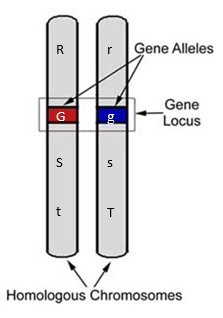
Figure 10.1: Gene locus. Each allelic pair, such as Gg, is located on homologous chromosomes at a particular gene locus.
Of the 23 pairs of chromosomes in each human cell, 22 are called autosomes and one pair are the sex chromosomes, designated X and Y. Autosomes carry most of the genes that determine an individual’s traits but typically do not have most of the genes associated with gender or reproduction. Sex chromosomes carry genes associated with gender and reproduction, along with other genes (see below).
Gregor Mendel, considered to be the Father of Genetics, published the results of his experimentation on the garden pea plant in 1866. Today, more than 150 years later, his work is still considered basic to our understanding of genetics. Mendel developed three fundamental laws of inheritance. The first law is the Law of Dominance, explaining how the dominant trait masks the recessive trait. The second law is the Law of Segregation. Whenever gametes are formed through the process of cell division called meiosis, each gamete receives only one chromosome from each pair of homologous chromosomes, hence the alleles found on the chromosome pairs “segregate” or separate. For example, with the genotype of Aa, the gametes may randomly receive the A or a allele. The third law is the Law of Independent Assortment, which explains that alleles of different traits separate independently of each other during gamete formation, meaning the inheritance of one trait does not influence the inheritance of another. The Law of Independent Assortment applies only to genes that are not linked, or situated on the same chromosome.
Note to students: Write all data and answers to questions on the Lab Report provided.
Activity 1: Determination of Genotypes and Phenotypes
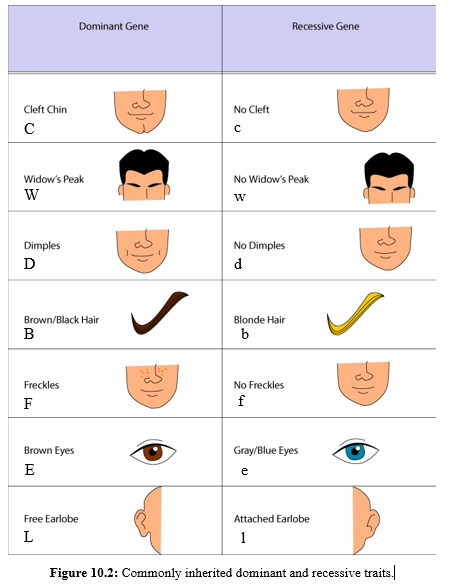
Figure 10.2 illustrates commonly inherited dominant and recessive traits. Using the information provided, answer the following questions:
- What is the genotype of an individual who is homozygous recessive for freckles?
- What is the genotype of an individual who is heterozygous for brown eyes?
- What is the genotype of an individual who is homozygous dominant for dimples?
- What is the phenotype of an individual with the genotype Cc?
- What is the phenotype of an individual with the genotype WW?
- What is the phenotype of an individual with the genotype ll?
PREDICTING PATTERNS OF INHERITANCE
Genetic inheritance follows certain patterns based on Mendel’s principles. Punnett square analysis can predict these patterns of inheritance. It provides a simple way to view patterns of inheritance for a single pair of alleles (monohybrid cross) and to calculate the probability that a particular genotype will be inherited (Figure 10.3). To create a Punnett square, place the possible alleles of the male gametes on the vertical (left) side and the possible alleles of the female gametes on the horizontal (top) side. The different combinations of alleles in their offspring are determined by filling in the boxes of the Punnett square with the possible combinations of alleles (letters). To calculate the probability of a specific offspring genotype or phenotype, divide the number of boxes in the square with that specific genotype or phenotype by the total number of boxes and multiply that number by 100. For example, if 3 out of 4 boxes show the dominant phenotype, the probability of that trait occurring in the offspring is ¾ or 75%. This can also be written as a ratio of dominant phenotype to recessive phenotype, in this case 3:1.
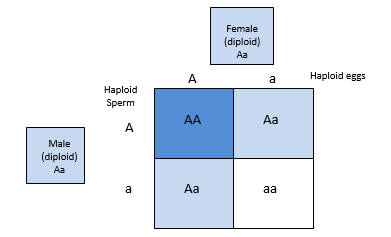
Figure 10.3: This Punnett square shows a cross between two heterozygotes. The genotypic ratio of the offspring is 1:2:1 (AA:Aa:aa, respectively). The phenotypic ratio of the offspring is 3:1, where the dominant trait is more likely to occur than the recessive trait. (Note: the dominant allele is always written before the recessive allele.)
As shown above, when a single pair of alleles are involved, it is known as a monohybrid cross. When two pairs of alleles, for two traits, are being studied, it is known as a dihybrid cross. In a dihybrid cross, there are four possible gamete types or combinations of alleles. The four combinations are written on the horizontal and vertical axes of the table, making a table with 16 boxes (4 x 4). The law of independent assortment assures that each allele of one trait can combine randomly with each allele of the second trait in the next generation. For example, when an individual is homozygous dominant for one trait (AA) and heterozygous for a second trait (Bb), the possible genotypes of the gametes are AB, Ab, AB, and Ab. (Figure 10.4)

Figure 10.4: Two pairs of alleles are assorted independently of each other in a dihybrid cross. The colors represent the individual alleles.
It is also important to understand the abbreviations that apply to generations. P1 is the parental generation, F1 is the first filial generation (in humans these are the children), and F2 is the second filial generation (in humans these are the grandchildren of the original cross). In Figure 10.3, the P1 is the female heterozygote crossing with the male heterozygote. The F1 generation are the offspring in the boxes.
Activity 2: Practicing Punnett Square Analysis of Complete Dominance
For each complete dominance genetic problem, (a) determine the parents’ genotypes based on Figure 10.2 illustration, (b) construct a Punnett square, and (c) record the resulting genotypes and phenotypes, expressed as percentages.
- Determine the results of a monohybrid cross of a mother who is heterozygous for a widow’s peak with a father who is homozygous recessive.
- Determine the results of a dihybrid cross of a mother who is homozygous dominant for dimples and heterozygous for freckles with a father who is heterozygous for dimples and homozygous recessive. Use a 16 box Punnett square to analyze this cross. What is the ratio of each possible combination of genotypes and phenotypes?
OTHER PATTERNS OF INHERITANCE
Complete dominance is only one type of pattern of inheritance. Other patterns include incomplete dominance, codominance, and sex-linked inheritance.
INCOMPLETE DOMINANCE
In incomplete dominance, neither allele is dominant over the other, and the heterozygote has an intermediate phenotype between the homozygous dominant and homozygous recessive phenotypes. An example of incomplete dominance is found in the petunia flower where the homozygous dominant phenotype has red flowers, the homozygous recessive has white flowers, and the heterozygote has pink flowers. An example of incomplete dominance in humans is hair texture. Curly hair is the homozygous dominant phenotype, and straight hair is the homozygous recessive phenotype, but the heterozygote phenotype is wavy hair. Since neither allele is fully dominant, genotypes of incomplete dominance do not use uppercase/ lowercase symbols. Alleles are represented by letters with superscripts. In the example of hair texture, homozygous dominant genotype is C1C1, homozygous recessive genotype is C2C2, and heterozygous genotype is C1C2.
CODOMINANCE
In codominance, both alleles for one trait are expressed in a heterozygote, resulting in a phenotype that displays both traits. An example of codominance in humans is blood type. Blood type also falls under multiple allele inheritance, where although a single individual inherits only two alleles for each gene, there are more than two possible alleles for that gene. Blood type has three different alleles of a single gene called the I gene: (1) allele IA causes red blood cells to carry A antigen, (2) allele IB causes red blood cells to carry B antigen, and (3) allele i carries neither A nor B antigen. In codominance, if an individual inherits both IA and IB alleles (heterozygous), they will have AB blood type. (Table 10.1)
Table 10.1: Genotypes and Phenotypes of Blood type
|
Genotypes |
Blood Type |
|
IAIA, IAi |
A |
|
IB IB, IBi |
B |
|
IA IB |
AB |
|
ii |
O |
SEX-LINKED INHERITANCE
Sex chromosomes determine the sex of an individual (XX in females and XY in males), but they also carry genes that control traits unrelated to sexual characteristics. Regardless of what the genes on the sex chromosomes control, all genes on those chromosomes are called sex-linked genes. The genes present on the X chromosome are said to be X-linked. The X chromosome is much larger than the Y, so there are many more genes present on the X chromosome than on the Y chromosome. The genes present on the Y chromosome are said to be Y-linked, and there are fewer Y-linked genes due to the difference in size between the two chromosomes.
X-linked recessive inheritance refers to a pattern of inheritance where the recessive allele is on the X chromosome. The phenotype of an X-linked recessive trait is expressed in males who have only one copy of the recessive allele, as there is no corresponding gene on the Y chromosome. Females have two X chromosomes, hence they have two alleles of each gene, and they would need two recessive alleles to express the phenotype. The X-linked recessive allele in a male is always inherited from his mother who passes on one of her X chromosomes to each child. The father passes on his Y chromosome to all of his sons. Sex-linked genes are symbolized by X with a superscript to represent the allele. The Y chromosome does not have the allele, so it does not have a superscript. (XCXc, XCY). An example of X-linked recessive inheritance is red-green color blindness, which is more prevalent in males due to the allele being absent on the Y chromosome. (Table 10.2)
Table 10.2: Genotype & Phenotype of X-linked recessive disorder: Red-Green Color Blindness
|
Genotype |
Phenotype |
|
XCXC |
Normal vision female |
|
XCXc |
Normal vision female (carrier) |
|
XcXc |
Red-green color-blind female |
|
XCY |
Normal male |
|
XcY |
Red-green color-blind male |
X-linked dominant inheritance refers to a pattern of inheritance where a single copy of the dominant allele on the X chromosome is enough to cause the dominant phenotype, affecting both males and females. X-linked dominant traits tend to affect females more than males because female have two X chromosomes, so it is possible a female could inherit the dominant X allele from either parent, while males have only one X chromosome and inherit it only from their mother.
Activity 3: Practicing Punnett Square Analysis of Other Patterns of Inheritance
For each genetic problem, (a) determine the parents’ genotypes based on Figure 10.2 illustration (b) construct a Punnett square, and (c) record the resulting genotypes and phenotypes expressed as percentages.
- Incomplete dominance: Determine the results of a monohybrid cross of a mother who is homozygous recessive for straight hair with a father who is heterozygous for curly hair.
- Codominance: Determine the results of a monohybrid cross of a mother who heterozygous for blood type B and a father who is homozygous dominant for blood type A. (Refer to Table 10.1 for genotypes.)
- X-linked recessive inheritance: Determine the results of a monohybrid cross of a mother who is a carrier of red-green color blindness and a father who has red-green color blindness. (Refer to Table 10.2 for genotypes.)
Activity 4: Creating your own Virtual Baby
In this activity, you and your lab partner will apply the laws of inheritance to predict what traits your offspring would have in a hypothetical (mock) pairing.
A. Determination of Phenotype and Genotype of P1 generation:
Each partner will record their own phenotype and the phenotypes of each of their parents for the following traits. Then determine the possible genotype(s) for each trait. Refer to Figure 10.2 to determine dominant versus recessive. Record this information on the Lab Report.
|
Trait |
Father’s Phenotype |
Mother’s Phenotype |
Your Phenotype |
Your Possible Genotypes (circle one or more genotypes per trait) |
|
Cleft chin |
|
|
|
CC Cc cc |
|
Widow’s peak |
|
|
|
WW Ww ww |
|
Dimples |
|
|
|
DD Dd dd |
|
Hair Color |
|
|
|
BB Bb bb |
|
Freckles |
|
|
|
FF Ff ff |
|
Eye Color |
|
|
|
EE Ee ee |
|
Earlobe Attachment |
|
|
|
LL Ll ll |
B. Determination of Phenotype of F1 generation:
Exchange information on your genes with your lab partner by filling out the following table on the Lab Report. Then draw a sketch of your hypothetical possible child that includes each of the traits.
|
Trait |
Your Genotype |
Partner’s Genotype |
Children’s Genotypic Ratio |
Children’s Phenotypic Ratio |
Most likely Phenotype of Child |
|
Cleft chin |
|
|
|
|
|
|
Widow’s peak |
|
|
|
|
|
|
Dimples |
|
|
|
|
|
|
Hair Color |
|
|
|
|
|
|
Freckles |
|
|
|
|
|
|
Eye Color |
|
|
|
|
|
|
Earlobe Attachment |
|
|
|
|
|
PEDIGREE ANALYSIS
A pedigree analysis is a method used to trace the inheritance of a specific trait or disease through multiple generations of a family. It helps determine the mode of inheritance (autosomal dominant, autosomal recessive, X-linked recessive, or X-linked dominant) and predict the likelihood of an individual inheriting the trait.

To determine if a pedigree shows autosomal dominant or autosomal recessive inheritance, the pattern of trait transmission across generations is analyzed. Autosomal dominant traits typically appear in every generation, while autosomal recessive traits can skip generations. (Figure 10.5).
(a) 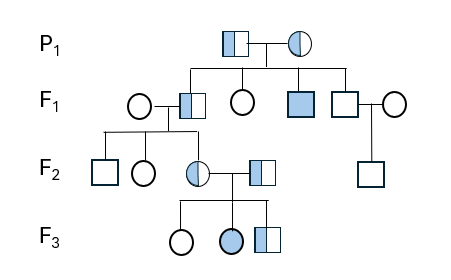 (b)
(b)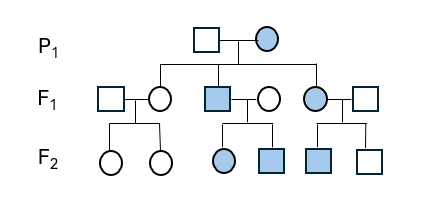
Figure 10.5: (a) Autosomal dominant pedigree depicts the affected individuals in every generation where both males and females are typically affected in equal proportions. If an individual is heterozygous for the dominant trait, they are symbolized as a fully shaded circle or square due to expressing the trait. (b) An autosomal recessive pedigree depicts the recessive trait skipping generations where both males and females are typically affected in equal proportions. If an individual is heterozygous for the recessive trait, they are symbolized as a half-shaded circle or square due to being a carrier of the trait but not expressing it.
To determine if a pedigree shows X-linked recessive inheritance, the pattern of inheritance across generations typically shows that males are affected by the trait more commonly than females. Females will be carriers (heterozygous) and not usually affected by the trait. The female will only be affected by the trait if their genotype is homozygous recessive (both X chromosomes have the recessive trait). (Figure 10.6)
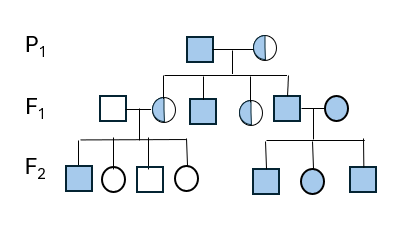
Figure 10.6: A pedigree shows an X-linked recessive inheritance pattern when the trait is more common in males. Affected males cannot pass the trait to their sons since they only contribute the Y chromosome, and unaffected carrier (heterozygous) females can pass the trait to their sons.
Activity 5: Constructing a Pedigree
Choose one of the traits provided in Figure 10.2 and draw a pedigree of you and your family members on the Lab Report, showing the traits in each individual on the pedigree. Include as many family members as you can: grandparents, parents, aunts, uncles, siblings and cousins. Reference the pedigree symbol key. If your family information is not available you may “borrow” information from another family or design a fictional family.
Activity 6: Lab Review
On the Lab Report, answer the questions in the Lab Review section.
Link to Lab Report: Lab 10 Human Genetics Lab Report
REFERENCES
Creation Wiki, the encyclopedia of creation science. (2014). Homologous chromosome. https://creationwiki.org/Homologous_chromosome
Education.com. (2025). Punnett Square: Dominant and Recessive Traits | Science https://www.education.com/science-fair/article/biology_it-takes/
Mader, Sylvia S. (2023). Laboratory Manual for Human Biology. 17th edition. McGraw-Hill.
Snider, Phillip and Terry Martin. (2024). Laboratory Manual to accompany Hole’s Essentials of Human Anatomy and Physiology. McGraw-Hill Publishing.
Starr, Cecie, Beverly McMillian, David Morton, James W. Perry, and Joy B. Perry. (2003). Lab Manual for Human Biology. Brooks/ Cole of Wadsworth Group.
Tortora, Gerard J. and Bryan H. Derrickson. (2020). Principles of Anatomy and Physiology, 16th edition. John Wiley and Sons.
Villano, Brianne. (2005). Virtual Babies Exercise. Wayne, NJ: William Paterson University.